
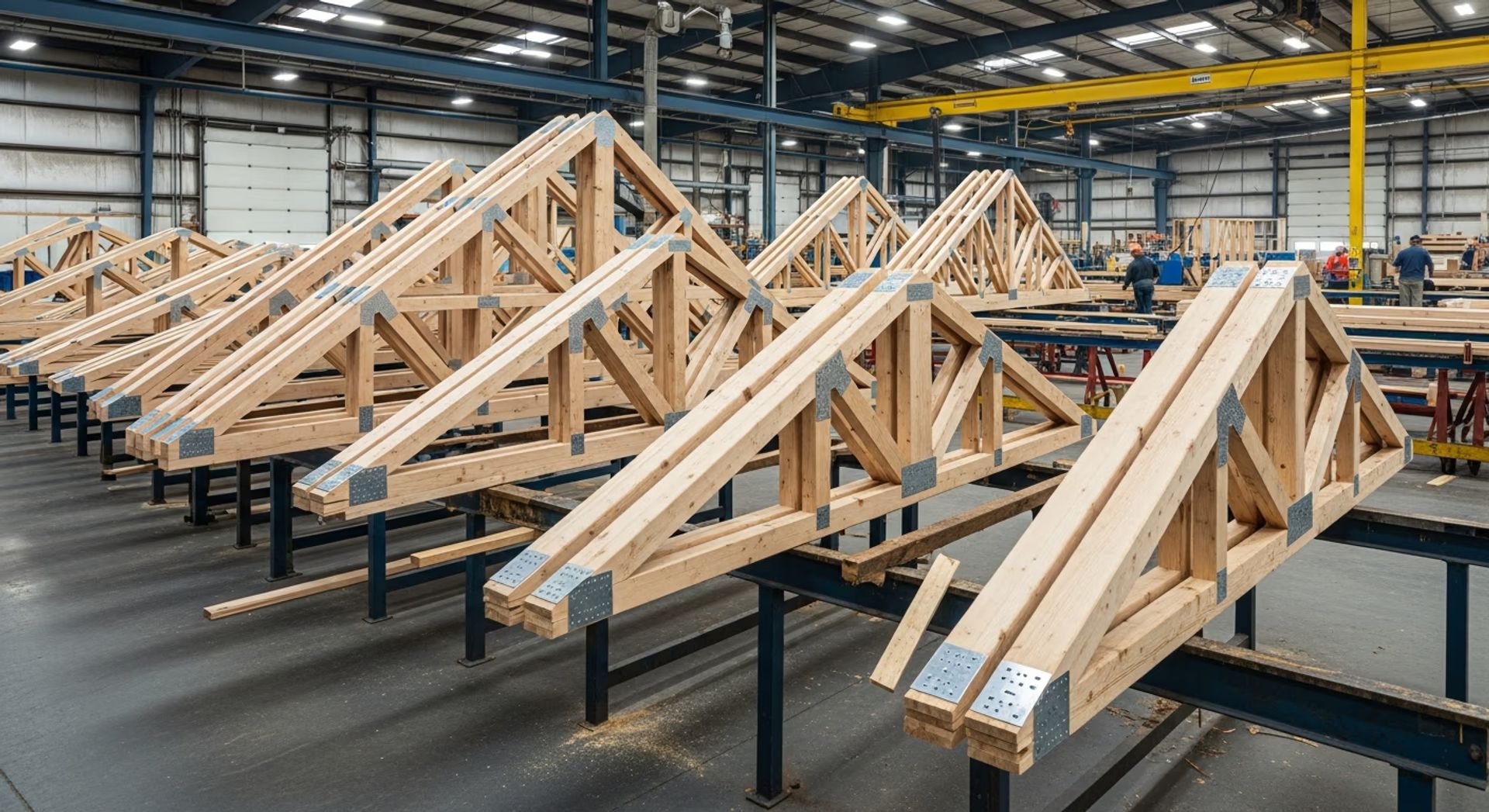
Types of Roof Trusses: A Builder's Guide to Choosing the Right Design
Picking the right truss type affects everything: your roof's strength, your project cost, and whether you get usable attic space. This guide covers 11 common truss designs with span ranges, relative cost, and the best application for each. If you're a builder, contractor, or architect planning a project, this is your reference.
Key Takeaways
71.8% of new US single-family homes use prefabricated trusses (Home Innovation Research Labs/SBCA). Fink (W) trusses are the most common residential type, spanning 20–60 feet at the lowest relative cost. Scissor trusses create vaulted ceilings; attic trusses add usable interior space within the roof. California projects require trusses engineered for Seismic Design Category D and Title 24 energy codes. Raised heel trusses save 4–6% on annual energy costs by allowing full-depth insulation at the eaves (APA/Nexant).
Key Takeaways
Over 71% of new US homes use prefabricated trusses (Home Innovation Research Labs). The Fink truss is the workhorse of residential construction, spanning 20–60 feet at the lowest cost tier. For vaulted ceilings, use scissor trusses. For usable attic space, use attic trusses. California builders must account for Seismic Design Category D requirements and Title 24 energy codes. Raised heel trusses save 4–6% on annual energy costs (APA/Nexant study).
Why Does Truss Type Matter?
The global roof truss market was valued at custom pricing billion in 2025, growing at 5.5% annually (Business Research Insights). That growth reflects a shift toward factory-built framing components over site-built methods. But not all trusses are the same. Each type is optimized for a specific combination of span, load, roof profile, and interior use. Choosing wrong costs money. Choosing right saves it.
In the US alone, the 34 largest truss-selling companies generated collective revenues of custom pricing billion in 2024, with approximately 21.6% coming from manufacturing operations (SBCA Construction Supply 150, 2025). Residential construction drives roughly 68% of truss demand nationally.
What Are the Most Common Residential Truss Types?
Fink (W) Truss
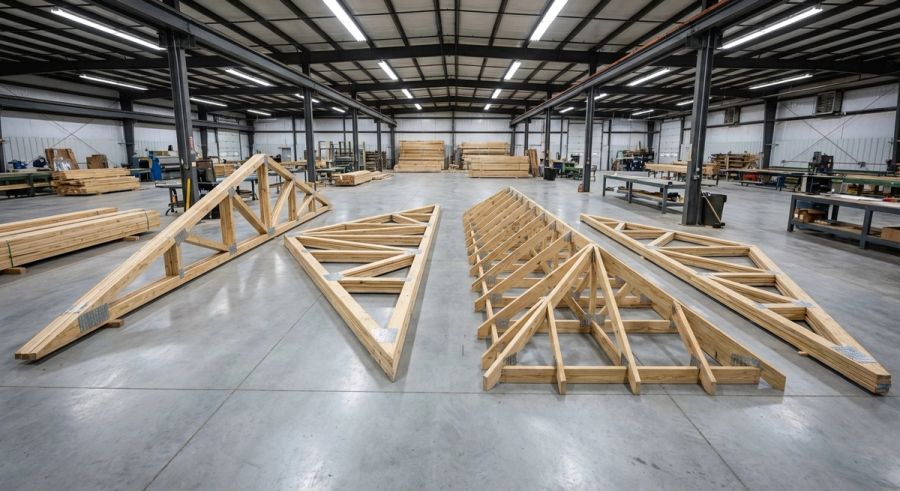
The Fink truss uses a W-shaped web pattern between the top and bottom chords. It's the most widely used residential truss because it efficiently distributes loads while using minimal lumber. Spans: 20–60 feet. Cost tier: Low. Best for: standard pitched roofs on single-family homes, multi-family units, and light commercial buildings. The web pattern blocks attic space, but that's fine when the attic is just for insulation and HVAC.
How dominant is the Fink design? It accounts for the majority of the 71.8% truss market share among new US homes (Home Innovation Research Labs). Builders default to it because the W-pattern delivers the best strength-to-material ratio for typical residential spans.
Truss Types: Quick Reference
King Post: up to 25 ft span, low cost, best for garages and sheds. Queen Post: 25-40 ft, low-mid cost, medium residential. Fink W-pattern: 20-60 ft, low cost, standard residential and the most common type. Howe: 30-70 ft, mid-high cost, commercial and heavy loads. Pratt: 40-70 ft, high cost, large commercial and industrial. Scissor: 20-50 ft, mid-high cost, vaulted and cathedral ceilings. Attic: 25-50 ft, high cost, usable room in attic space. Gambrel: 20-45 ft, mid-high cost, barns and max upper volume. Hip system: 20-60 ft, high cost, hip roofs and wind resistance. Mono: 10-40 ft, low cost, additions and single-slope. Floor parallel chord: 20-60 ft, mid-high cost, floor systems and flat roofs.
In our shop, Fink trusses probably account for 60-70% of what we build on any given week. They're the workhorse. But here's what most guides don't tell you: the specific web configuration within a Fink truss varies significantly based on span and load. A 24-foot Fink looks nothing like a 48-foot Fink internally, even though they share the same name.
In our shop, Fink trusses probably account for 60-70% of what we build on any given week. They're the workhorse. But here's what most guides don't tell you: the specific web configuration within a Fink truss varies based on span and load. A 24-foot Fink looks nothing like a 48-foot Fink internally, even though they share the same name.
King Post Truss
The simplest truss design: one central vertical post with two rafters and a bottom chord forming a triangle. Spans: up to 20–25 feet. Cost tier: Low. Best for: garages, sheds, small additions, and simple extensions. Not suitable for wider buildings.
Queen Post Truss
An evolution of the King Post with two vertical posts instead of one, connected by a horizontal straining beam. Handles slightly longer spans. Spans: 25–40 feet. Cost tier: Low-Mid. Best for: medium-sized residential buildings and light agricultural structures.
Howe Truss
Vertical and diagonal web members create a balanced, strong design suited for heavier loads. The diagonals angle inward from the bottom chord. Spans: 30–70 feet. Cost tier: Mid-High. Best for: commercial buildings, larger residential, and structures with heavy uniform loads.
Pratt Truss
The inverse of the Howe: diagonals angle outward, putting them in tension under load. Very efficient for long spans. Spans: 40–70 feet. Cost tier: High. Best for: large commercial and industrial buildings needing significant clear spans.
Which Truss Types Create Vaulted Ceilings or Usable Space?
Scissor Truss
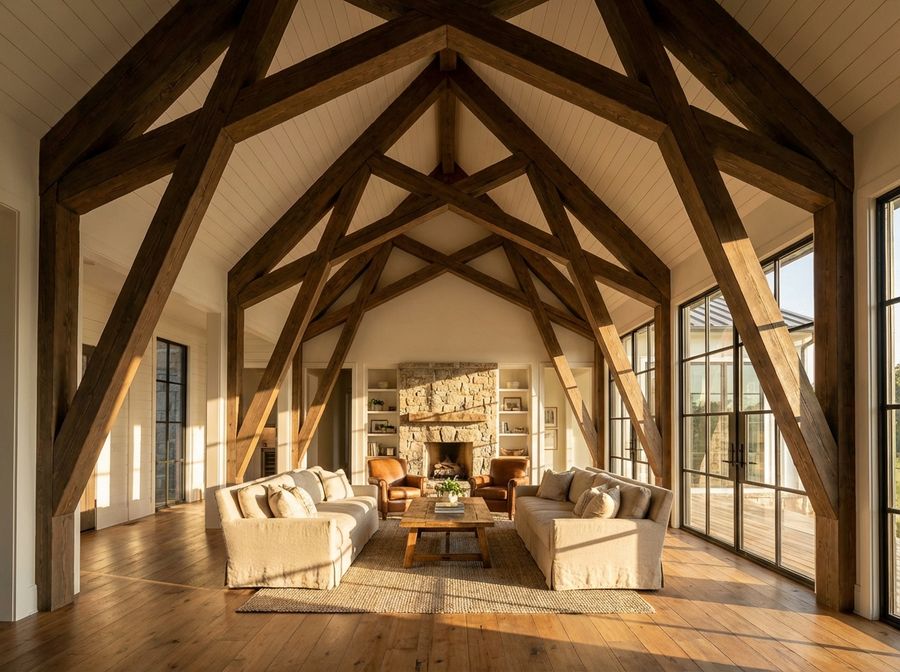
The bottom chord angles upward from the walls toward the center, creating a vaulted or cathedral ceiling effect. You get dramatic interior volume without complex on-site framing. Spans: 20–50 feet. Cost tier: Mid-High. Best for: living rooms, great rooms, retail spaces, and anywhere you want an open, airy ceiling. This is the go-to for vaulted designs.
A word of caution from experience: scissor trusses look great in the finished home, but they're one of the trickier types to get right. The bottom chord angle has to be coordinated precisely with the drywall contractor and the insulation plan. We always recommend a pre-construction meeting between the truss engineer, framer, and drywall crew on scissor truss jobs. Skipping that meeting is how you end up with wavy ceilings.
Attic (Room-in-Attic) Truss
Designed with an open rectangular section in the center, creating a usable room or storage area inside the roof. The bottom chord is heavier to function as a floor joist. Spans: 25–50 feet. Cost tier: High. Best for: adding a bedroom, office, or storage without building a full second story. A cost-effective way to maximize square footage.
Gambrel Truss
Two distinct slopes on each side: shallow upper and steep lower, like a classic barn shape. Maximizes interior volume. Spans: 20–45 feet. Cost tier: Mid-High. Best for: barns, outbuildings, and homes wanting that traditional profile with usable upper space.
What About Specialty Truss Types?
Hip Truss System
A hip roof uses a combination of standard trusses, hip girders, and jack trusses that gradually shorten toward the corners. The hip girder carries loads from the jack trusses. Spans: varies by design, main trusses 20–60 feet. Cost tier: High (more engineering, more unique pieces). Best for: any building wanting a hip roof profile with overhangs on all sides. Popular in residential for aesthetics and wind resistance.
Mono (Lean-To) Truss
A single-slope design: one top chord, one bottom chord, connected by webs. Half of a standard gable truss. Spans: 10–40 feet. Cost tier: Low. Best for: additions against existing buildings, carports, sheds, and contemporary single-slope roofs.
Parallel Chord (Floor) Truss
Parallel top and bottom chords with an open web system. Primarily used for floors, not roofs. The open webs let plumbers, electricians, and HVAC trades route their systems through the floor without drilling. Spans: 20–60 feet. Cost tier: Mid-High. Best for: floor systems in multi-story residential, multi-family, and commercial buildings. Also used for flat roof applications.
How Do California Codes Affect Truss Selection?
Building in California means designing for seismic forces and energy efficiency. Sacramento sits in Seismic Design Category D under the California Building Code, which requires trusses engineered for lateral load resistance with specific hardware connections and bracing (City of Sacramento Building Safety Design Criteria).
Title 24 energy codes require high insulation levels at the roof plane. Raised heel (energy) trusses solve this by extending the heel height at the eaves, allowing full-depth insulation where standard trusses pinch down to just a few inches. Research by APA and Nexant Energy found raised heel trusses improve HERS ratings by 4–6 points and save 4–6% on annual energy costs.
Under the 2025 California Building Code, metal-plate-connected trusses used as drag or collector elements in seismic force-resisting systems must have their plate design strength reduced by 20%. Stapled connections are prohibited in roof and floor panels in Seismic Design Categories D0 through D2 (DSA IR 23-4, California Division of State Architect). These requirements make engineering a non-optional step for any California truss project.
We've had builders from out of state assume California truss engineering is the same as what they're used to in Texas or Arizona. It isn't. The seismic connection details alone add 15-20 additional hardware specs per project compared to a non-seismic state. Our engineering team handles this automatically, but if you're getting quotes from out-of-state manufacturers, make sure they actually design for SDC D, not just say they do.
Fire ratings matter for multi-family and certain commercial projects. Trusses can be designed with fire-resistant treatments or specific assemblies to meet 1-hour or 2-hour fire ratings required between dwelling units.
How Do You Choose the Right Truss for Your Project?
Start with three questions: What span do I need? What do I want the interior ceiling to look like? Do I need usable attic space? The answers narrow your options quickly.
Cost matters too. The California Construction Cost Index rose 3.9% in 2025 (DGS California), and construction costs remain 25-28% above pre-2020 levels. Choosing the right truss type, not over-engineering, is one of the few places you can control material cost without sacrificing structural performance.
For a standard home with a simple gable or hip roof and no attic needs, a Fink truss is the economical default. Want a vaulted ceiling in the great room? Scissor truss. Need a bonus room upstairs without building a full second story? Attic truss. Small addition leaning against the house? Mono truss.
A design consultation with your truss manufacturer early in the planning phase saves money downstream. Changes are cheap on paper and expensive once lumber is cut. Our engineering team at Mike Walker Lumber Co Inc offers free consultations to help you pick the right type for your project.


About Mike Walker Lumber Co Inc
Mike Walker Lumber Co Inc is a family-owned truss manufacturer in North Highlands, CA, serving builders across Northern California since 1974. Contact (916) 338-2121 or walkerlumber.com for a free estimate.
Frequently Asked Questions
01 What's the most common residential truss type?
The Fink (W) truss is the most widely used in residential construction. Its web pattern efficiently distributes loads while minimizing lumber usage, making it the most economical choice for standard pitched roofs spanning 20–60 feet.
02 Can trusses create a vaulted ceiling?
Yes. Scissor trusses have an angled bottom chord that creates a vaulted or cathedral ceiling without complex on-site framing. They span 20–50 feet and are the standard choice for vaulted designs in living rooms, great rooms, and retail spaces.
03 How do California seismic codes affect trusses?
Sacramento's Seismic Design Category D requires trusses engineered for lateral earthquake forces with specific connection hardware and bracing. This is standard for any California truss manufacturer but adds engineering complexity compared to lower-seismic states.
04 What factors affect truss cost by type?
Span length, design complexity, load requirements, lumber grade, and quantity all affect pricing. Standard Fink trusses are the most economical. Scissor, attic, and hip trusses cost more due to additional material, engineering, and specialized fabrication.
05 Do raised heel trusses save energy?
Yes. APA research with Nexant Energy found raised heel trusses improve HERS ratings by 4–6 points and save 4–6% on annual energy costs by allowing full-depth insulation at the eaves where standard trusses pinch the insulation thin.