
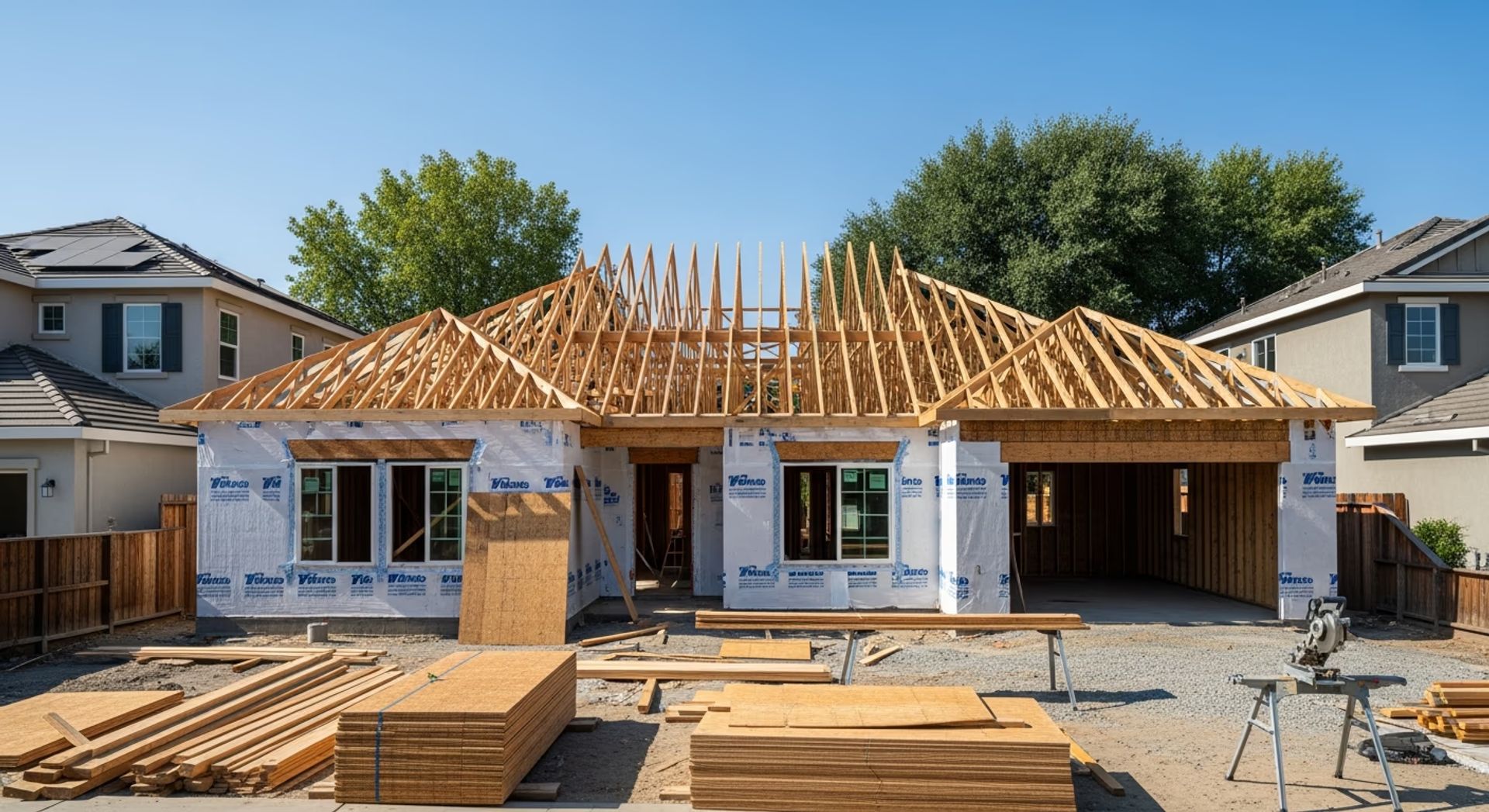
Roof Trusses vs Rafters: Which Is Better for Your Sacramento Home?
Trusses or rafters? It's one of the first structural decisions on any Sacramento build. Both hold up your roof, but they differ in cost, speed, strength, and what you can do with the attic space. Here's an honest breakdown based on industry data and 50+ years of truss manufacturing.
Key Takeaways
Trusses reduce framing labor by 60%: 152 man-hours vs 375 for stick framing (SBCA). Jobsite waste drops from 15 cubic yards (rafters) to 0.5 cubic yards (trusses), a 30x reduction. 71.8% of new US single-family homes use prefabricated trusses (Home Innovation Research Labs). Rafters win for exposed beam aesthetics and open attic conversions, but attic trusses offer a hybrid solution. Sacramento's Seismic Design Category D makes engineered trusses the easier path to code compliance.
Key Takeaways
Trusses cut framing labor by 60% and generate 30x less jobsite waste than rafters (SBCA). They're used in 71.8% of new US homes (Home Innovation Research Labs). Rafters still make sense for exposed beam ceilings and very small projects. In Sacramento's Seismic Design Category D, engineered trusses simplify code compliance. Cost difference: trusses save 30–50% on total roof framing when you factor in labor.
What's the Actual Difference Between Trusses and Rafters?
A roof truss is a prefabricated, factory-built frame made of lumber chords and webs joined with steel connector plates. It arrives at your job site ready to lift and set. A rafter is a single piece of dimensional lumber (2x8, 2x10, or 2x12) cut and assembled on-site by framers, running from the exterior walls to a ridge beam.
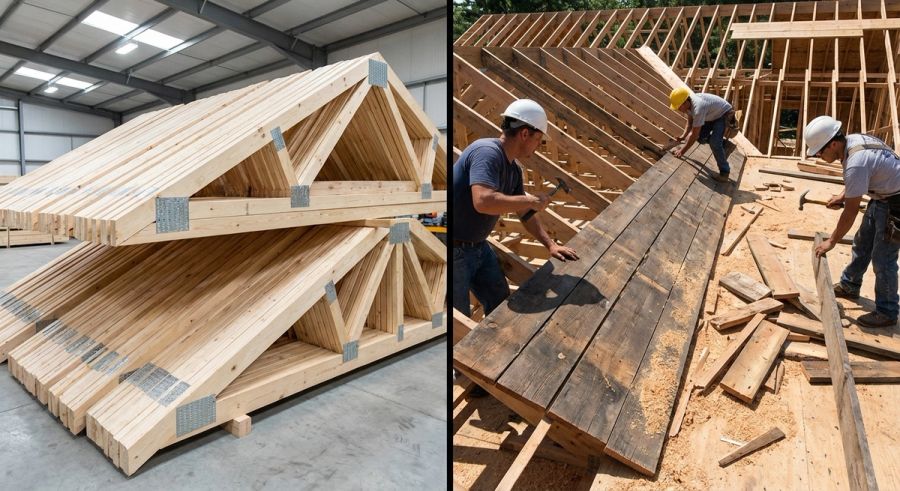
The practical difference? Trusses distribute load through a triangulated web system, letting them span wider distances with lighter lumber. Rafters rely on the depth and grade of each individual board. One is engineered in a factory. The other depends on the skill of whoever's holding the nail gun that day.
We see this play out regularly. A skilled framing crew can stick-frame a beautiful roof. But on production builds where you're framing 20 or 50 homes, consistency matters more than any one framer's skill. That's where factory trusses win: house number 50 gets the same precision as house number 1.
This distinction matters at scale. According to Home Innovation Research Labs, 71.8% of new single-family homes in the US now use prefabricated trusses, with 42.4% using trusses exclusively and 29.4% using a hybrid approach (SBCA). The remaining 28.2% rely on stick framing alone.
Which Costs Less: Trusses or Rafters?
Trusses win on total project cost for most builds. The SBCA's Framing the American Dream study measured it directly: a truss-framed home required 152 man-hours of framing labor vs 375 man-hours for stick framing. That's 60% less labor. At California's median carpenter wage of competitive hourly rates (BLS, 2024), the labor savings alone can reach significant cost savings on a typical home.
Material costs tell a similar story. The same SBCA study found stick-framed homes used 20,643 board feet of lumber compared to 15,052 for truss-framed homes. That's 25% more wood for the same house. And the waste? Stick framing left 15 cubic yards of debris on site vs just 0.5 cubic yards for component framing.
Raw material cost per square foot can look similar on paper. But when you add labor, waste disposal, and the time value of a faster build, trusses typically save 30–50% on the complete roof framing scope.
Trusses vs Rafters: Head-to-Head
Installed Cost/sq ft: Trusses offer significant cost savings vs Rafters
Framing Labor Hours: Trusses: 152 hrs vs Rafters: 375 hrs
Installation Time: Trusses: 1–2 days vs Rafters: 3–7 days
Jobsite Waste: Trusses: 0.5 yd³ vs Rafters: 15 yd³
Lumber Used: Trusses: 15,052 board ft vs Rafters: 20,643 board ft
Clear Span: Trusses: up to 70 ft vs Rafters: up to 24 ft
Attic Space: Trusses: blocked by webs vs Rafters: open
Quality: Trusses: factory-controlled vs Rafters: crew-dependent
Sources: SBCA Framing the American Dream, PACC Solutions 2025, HomeGuide 2026.
How Much Faster Are Trusses to Install?
Speed is where trusses really pull ahead. A crew can set trusses for a typical residential roof in one to two days. The same roof stick-framed with rafters takes one to two weeks. That's not an exaggeration. The SBCA study found framers could complete 2.5 truss-framed homes in the time it took to stick-frame one.
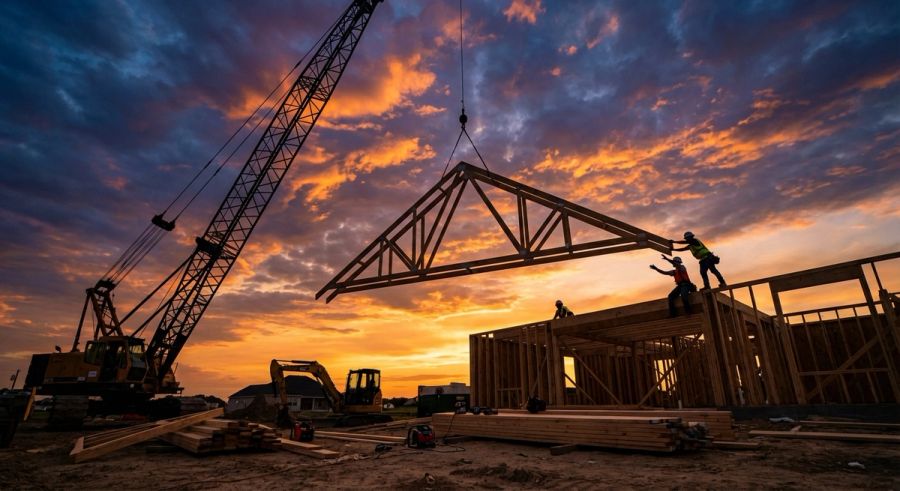
Why does speed matter beyond bragging rights? A faster dry-in means less weather exposure for the interior. It lets plumbers, electricians, and HVAC trades start sooner. And in construction, time is overhead: insurance, equipment rental, financing. Every week you shave off the schedule saves real money.
Here's a real example from our production schedule. A builder in Elk Grove was framing a 2,400 sq ft custom home. Our crew delivered and the framing team set all 32 trusses by 2 PM the same day. The builder next door on a similar-sized home was into day six of stick-framing the rafters. Same neighborhood, same week, very different timelines.
Industry cost data backs this up. PACC Solutions reports installed truss costs of custom per square foot pricing, with labor specifically running custom per square foot pricing(PACC Solutions, 2025). On a 2,000 sq ft roof, that labor difference alone is significant savings.
Which Is Structurally Stronger?
Engineered trusses provide predictable, certified structural performance. Every truss is designed by an engineer using load analysis software that accounts for dead loads, live loads, wind, snow, and seismic forces. The result is a structure that's been calculated, not estimated.
Rafters can be perfectly strong when built by skilled framers following proper span tables. But the consistency depends on the crew. In Sacramento's Seismic Design Category D, engineered trusses simplify code compliance because the lateral-force connections and bracing are designed into the system from the start. Rafter systems need the same engineering attention, but it's applied on-site rather than in a factory.
Factory truss production also generates far less waste: 3-5% material loss compared to 10-15% for site-built rafter framing (West Fraser). The SBCA study measured 0.5 cubic yards of jobsite waste for truss-framed homes vs 15 cubic yards for stick-framed, a 30x difference.
For energy efficiency, trusses offer another edge. Raised heel trusses allow full-depth insulation at the eaves, where standard framing creates a thin spot. APA research with Nexant Energy found this can improve HERS ratings by 4–6 points and save 4–6% on annual energy costs.
We've been specifying raised heel trusses on nearly every residential order since California tightened Title 24 requirements. The cost difference is minimal, maybe significant cost-significant cost savings on a typical home, but it makes the energy inspection a non-issue. In our experience, that small upcharge pays for itself in avoided compliance headaches.
What About Attic Space?
This is the one area where rafters have a clear advantage. Standard Fink trusses fill the attic with diagonal webs, leaving no usable space. Rafters create a naturally open cavity between the roof and ceiling.
But it's not all-or-nothing. Attic trusses (also called room-in-attic trusses) are designed with an open rectangular center that creates usable living or storage space. They cost more than standard trusses but less than building a full second story. If you need attic space, ask about attic truss designs during your design consultation.
When Do Rafters Make More Sense?
Rafters aren't obsolete. They're the better call in a few specific situations:
Exposed beam ceilings: If you want visible wood beams as an interior design feature, rafters deliver that look naturally. Cathedral ceilings with exposed timber are hard to replicate with trusses.
Very small projects: A tiny shed, a small bump-out, or a repair to an existing rafter roof. The delivery cost for a handful of trusses may not make economic sense.
Historic renovations: Matching an existing rafter roof on a period home often requires stick framing to preserve the original construction method.
Extreme custom geometry: Highly curvilinear or irregularly shaped roofs with many unique angles. Rare, but it happens.
When Are Trusses the Clear Winner?
For the vast majority of Sacramento projects, trusses win. New construction (single-family and multi-family), cost-sensitive builds, engineered strength requirements, fast schedules, and code compliance in Seismic Design Category D all favor prefabricated trusses. The 71.8% market share among new US homes reflects that reality.
If you're building new, remodeling with a roof change, adding a second story, or constructing an ADU, trusses will almost certainly save you money and time. Talk to your truss manufacturer early in the design phase for the best result.


About Mike Walker Lumber Co Inc
Mike Walker Lumber Co Inc is a family-owned truss manufacturer in North Highlands, CA, serving builders across Northern California since 1974. Contact (916) 338-2121 or walkerlumber.com for a free estimate.
Frequently Asked Questions
01 Can I convert a truss attic into living space?
Standard trusses obstruct the attic with webbing. But attic trusses (room-in-attic design) create an open center section for living or storage space. They cost more than standard trusses but less than building a full second story. Discuss this during design consultation.
02 Are trusses really stronger than rafters?
Trusses are engineered for specific loads using software that calculates dead, live, wind, snow, and seismic forces. Rafters can be equally strong when properly built, but consistency depends on the crew. In Sacramento's Seismic Design Category D, engineered trusses simplify code compliance.
03 Do trusses limit roof design options?
No. Modern truss manufacturing handles hip roofs, valleys, dormers, varying pitches, and complex intersections. The 71.8% market share among new homes shows trusses work for almost any residential design. Only extreme custom curves are impractical.
04 How do California building codes affect the choice?
Sacramento's Seismic Design Category D and Title 24 energy codes favor engineered trusses. Seismic connections are designed into the truss system. Raised heel trusses help meet Title 24 insulation requirements at the eaves, saving 4–6% on energy costs (APA/Nexant study).